
Engineering Density: Structuring Vertical Gardening for Urban Real Estate
The constraint of limited horizontal space in dense urban environments fundamentally shifts our approach to cultivation. We are no longer simply arranging pots on a flat plane; we must begin designing three-dimensional growing systems. This necessity drives the adoption of vertical gardening urban strategies, which transform otherwise inaccessible wall surfaces or vertical supports into productive growing media. Observing this trend suggests an inherent human desire to reclaim neglected vertical real estate for food production, effectively mitigating spatial scarcity through architectural innovation.
This method operates on principles of maximizing surface area utilization per square meter. A standard horizontal garden maximizes ground coverage; a vertical system multiplies it exponentially by introducing layers of cultivation. We analyze the structural mechanics required for these systems. The stability of any living wall or trellis is not accidental; it depends entirely on load distribution, substrate integrity, and proper anchoring into the building structure itself. Ignoring these engineering fundamentals results in inevitable structural failure, which is unacceptable when dealing with live plant matter.
Material Science Behind Vertical Structures
Selecting the right materials dictates the system’s longevity and yield potential. We encounter a spectrum of options, ranging from simple wooden slats to complex hydroponic panel systems. Wood offers warmth and natural aesthetics but requires careful treatment against moisture penetration and fungal decay common in damp urban settings. Metal structures, such as galvanized steel or aluminum, provide superior tensile strength, resisting the weight of saturated soil and heavy foliage effectively.
The choice must account for water management. When plants are grown vertically, the rate at which water is delivered and managed becomes a critical operational factor. Systems employing hydroponic channels or self-watering pockets manage this delivery with precise control, minimizing runoff and maximizing root access to consistent moisture levels. Contrast this with traditional soil-based vertical setups where managing drainage across multiple stacked layers requires meticulous attention to substrate permeability.
Optimizing Plant Placement and Light Exposure
Light exposure is the primary limiting factor in any indoor or semi-shaded urban garden. A wall covered by greenery, while beautiful, must still provide adequate Photosynthetically Active Radiation (PAR) for the specific cultivars being grown. We observe that plants positioned higher up receive differential light intensity compared to those lower down, creating microclimates within the structure itself.
We need to map this exposure precisely during the design phase. Plants requiring intense, direct sun should occupy the uppermost tiers or exterior facades. Shade-tolerant varieties can be situated in areas receiving diffused light from adjacent structures. This spatial awareness prevents yield reduction caused by suboptimal light conditions. Furthermore, dense planting on a vertical surface risks self-shading, where lower leaves block necessary light from upper stems, thereby reducing overall biomass production across the entire plane.
Integrating Trellises for Climber Cultivation
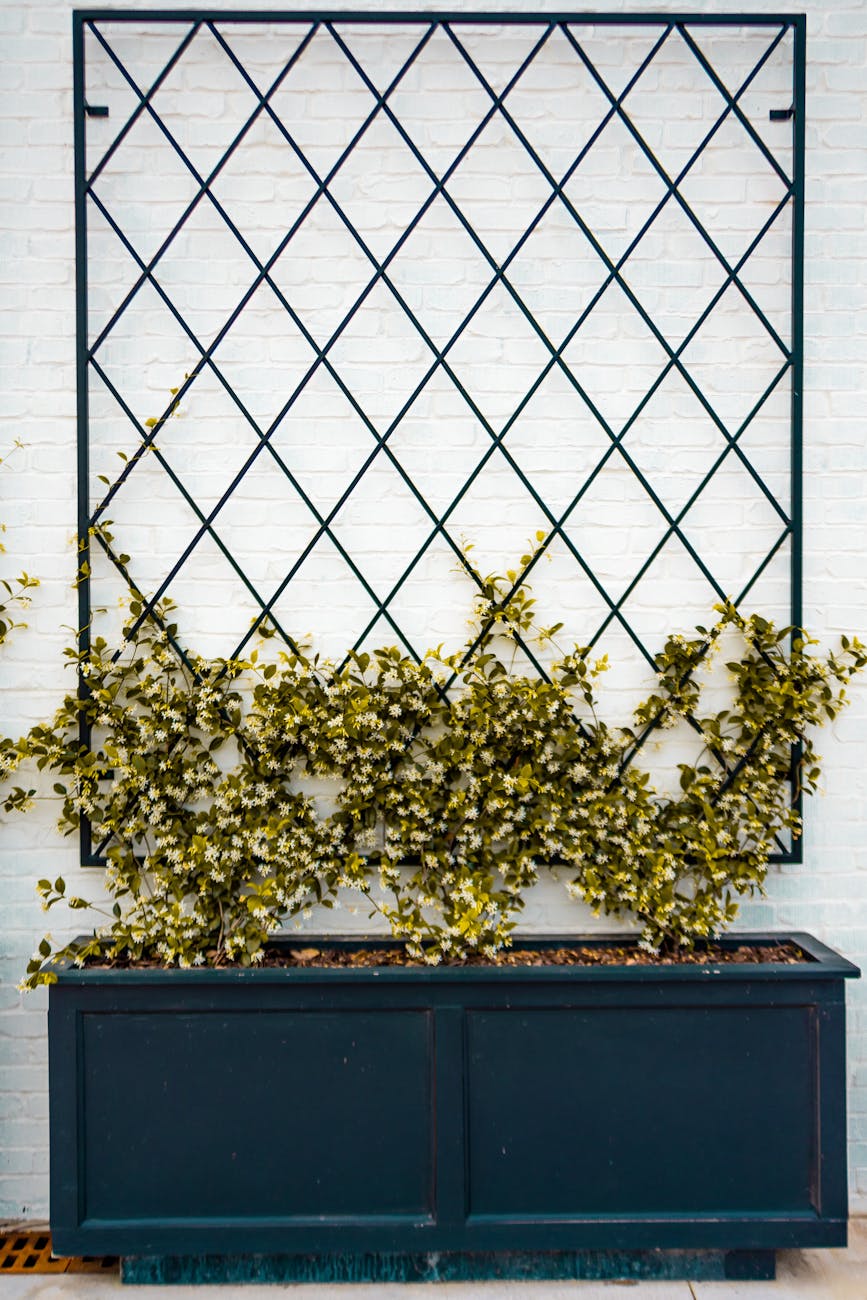
Trellising systems serve a distinct function compared to solid living walls; they provide the necessary supportive infrastructure for plants with climbing habits, allowing them to exploit vertical growth potential without relying solely on a flat surface. This technique effectively converts linear space into productive pathways for vines and beans.
The structural integrity of trellises must account for the specific plant load. A sturdy trellis designed for heavy, woody climbers requires robust anchoring points embedded deep within the supporting wall structure, often necessitating specialized mounting hardware resistant to shear stress. We see a direct correlation: stronger support allows for denser foliage, which in turn increases photosynthetic surface area and overall yield per vertical foot of space utilized.
The Mechanism of Vine Support
When implementing a trellis system, we are essentially creating an artificial scaffolding that guides the plant’s growth trajectory toward optimal light exposure and efficient nutrient uptake. For gourds or cucumbers, the vines need to travel vertically upward to maximize sun exposure during the critical flowering stages. If the support is weak, the vine will bend under its own weight, leading to stunted growth and wasted potential.
In practice, utilizing modular systems allows for adaptable scaling. A gardener can start with a simple grid and incrementally add stronger supports as the plant matures and develops more vigorous stems. This incremental approach minimizes initial material investment while ensuring the system can scale with increasing plant biomass. We see this adaptability translating directly into better harvest yields when cultivating crops like beans or peas, which benefit immensely from vertical ascension.
Substrate Management in Vertical Systems
The medium used to grow plants vertically presents a unique challenge regarding moisture retention and nutrient delivery across multiple planes. Soil-based systems require careful management of water saturation; if one layer becomes overly saturated, the entire structure risks collapse due to increased dead weight.
Therefore, substituting traditional soil with engineered growing media is often necessary for stability in vertical setups. We look at options like specialized potting mixes or aerated substrates that offer excellent drainage while retaining sufficient moisture capacity. When dealing with these layered systems, ensuring that water moves vertically without pooling at the base layer becomes paramount to preventing root asphyxiation in lower tiers.
The selection of substrate directly influences the rate at which water and nutrients are delivered to the roots. If the medium compacts too quickly, root growth stagnates despite abundant resources being supplied externally. We must consider how these substrates interact with the anchoring system; porous materials allow for better interaction with the wall structure’s ability to manage moisture fluctuations. For instance, experimenting with amendments like those used in container gardening, such as incorporating specialized organic matter into vertical substrates, can enhance overall water retention capacity while maintaining necessary aeration. Explore resources on DIY Soil Amendments for Concrete: Urban Gardening Solutions to understand how material properties affect substrate performance in constrained spaces.
Scaling Yields Through Integrated Systems
The true advantage of vertical gardening urban lies not just in the physical space occupied, but in the cumulative yield achieved per unit of wall area. By integrating living walls with supportive trellises, we establish a synergistic system where each component enhances the functionality of the others. A structure designed for heavy foliage (the living wall) can simultaneously support climbing crops (the trellis), maximizing the return on investment for limited urban acreage.
We observe that systems incorporating hydroponic elements within vertical frames offer unparalleled control over nutrient concentration and delivery, which directly impacts the density and quality of the harvest. This level of precision moves cultivation from an art based on intuition to a science based on measurable inputs and outputs. The ability to monitor root health via integrated sensors, for example, allows cultivators to adjust irrigation schedules dynamically, preventing both overwatering and nutrient depletion simultaneously.
Container gardening techniques, when adapted vertically, demonstrate this principle clearly. By mastering the principles of managing soil volume and ensuring proper drainage in smaller vessels, we learn how to coax maximum yield from minimal space. Applying these container management skills to vertical systems forces a higher level of spatial efficiency, pushing the limits of what can be achieved in confined urban settings. For those focused purely on culinary output, understanding the nuances of growing flavorful herbs efficiently is key; consider optimizing your cultivation through methods detailed in Container Gardening for Flavorful Herbs in Small Urban Spaces.
The result of this integrated engineering—combining structural support, optimized light exposure, and precise substrate management—is a highly productive, aesthetically pleasing urban ecosystem. We are transforming passive architectural surfaces into active food production zones. This demands an analytical approach, treating the wall not as a boundary, but as a functional growth surface ready to be engineered for abundance.
Tags: vertical gardening, urban gardening, living walls, trellises, small space gardening, city gardening, vertical farming
Featured Image by Caleb Oquendo on Pexels.